
Built for Freight. Deployed for Families.
The AI safety system installed in the LuxShuttle Sprinter was not designed for luxury ground transportation. It was engineered for commercial trucking — Class 8 semis hauling freight worth millions across interstate corridors, where the consequences of a single moment of inattention are measured in lives and in losses that reshape entire companies.
The system was purpose-built for an industry where failure is not an inconvenience but a catastrophe. It monitors operators who drive eighteen-wheelers for twelve-hour shifts across thousands of miles. It was designed to catch the things that human oversight cannot: the microsleep at mile eight hundred, the momentary glance at a phone, the gradual drift across a lane line that begins so slowly the person at the wheel does not notice until it is too late.
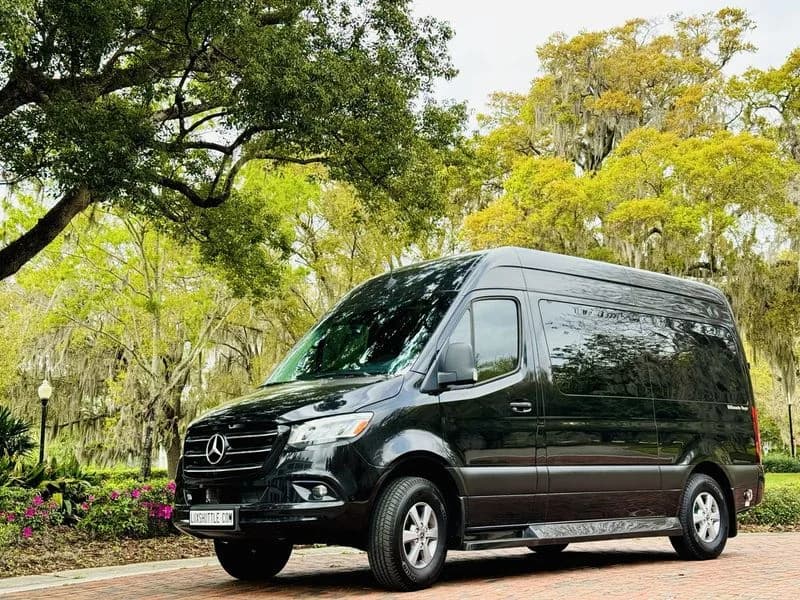
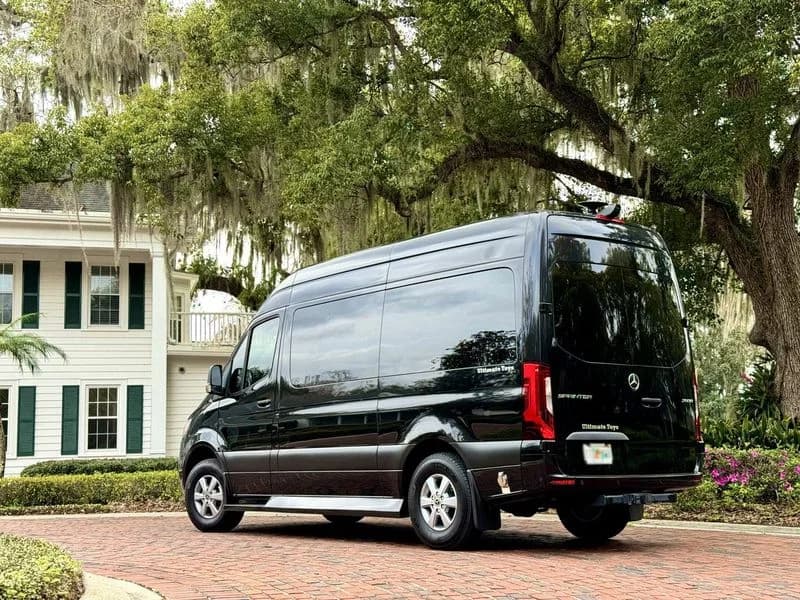
No luxury chauffeur service in Atlanta — or, as far as we are aware, anywhere — had deployed this system in a private passenger vehicle. We are the first. The reasoning was straightforward: if this level of continuous AI oversight exists to protect cargo, it should exist to protect the people we are responsible for carrying.
What Five Cameras and Continuous AI Analysis Actually Means
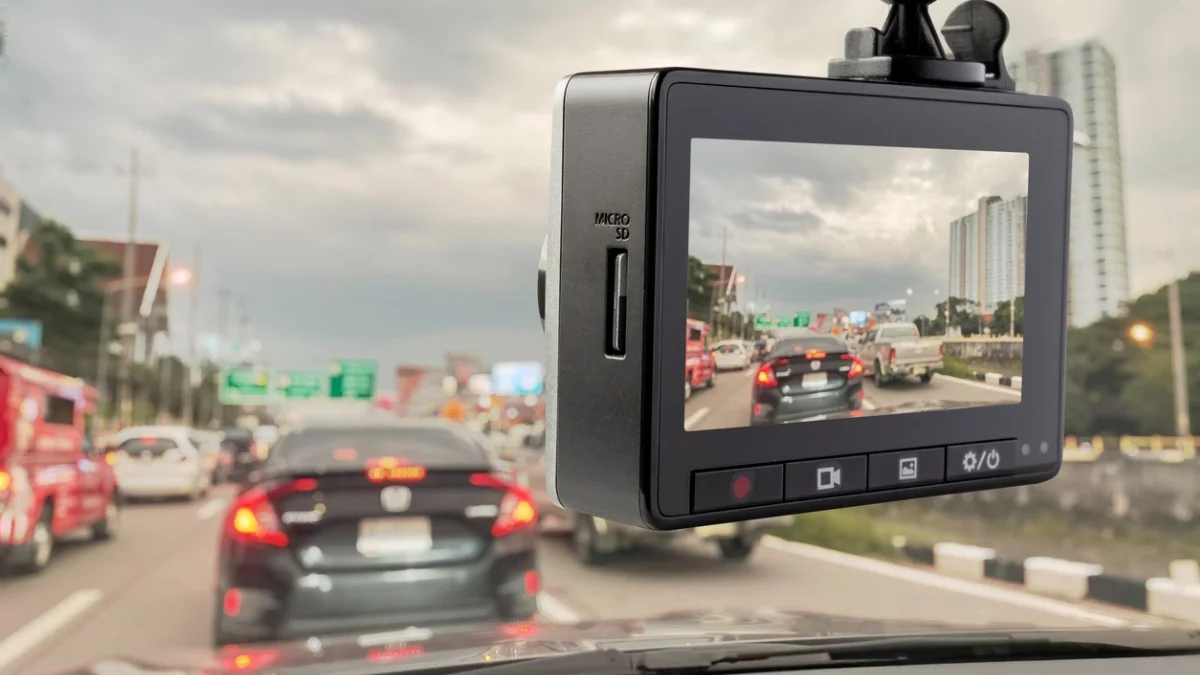
The system comprises five cameras providing full 360-degree coverage. The forward-facing camera captures 143 degrees of the road ahead. The interior camera spans 170 degrees of the cabin. Three additional cameras eliminate every remaining blind spot — side angles, rear approach, and peripheral zones that conventional dashcam systems leave unmonitored.
The critical distinction is that these cameras are not merely recording. They are analyzing. The AI processes the feed from all five cameras continuously — not in batches, not after the fact, but in real time, every second the vehicle is in motion. It is the difference between a security camera that stores footage for later review and a trained observer who is watching the feed live, every moment, with the authority to act immediately.
Chauffeur Monitoring
The AI watches with the same scrutiny a fleet safety officer would apply — except it does not blink, does not lose focus, and does not step away for a break. It detects:
- Fatigue and drowsiness — identifying the earliest physiological indicators before the person at the wheel is consciously aware of impairment
- Distraction — eyes off the road beyond acceptable thresholds
- Cell phone usage — detected and flagged immediately
- Seatbelt compliance — verified continuously, not once at ignition
- Hands on the wheel — monitored throughout the journey
- Yawning — tracked as a fatigue precursor, not dismissed as incidental
Vehicle and Driving Behavior
Beyond the chauffeur’s physical state, the AI evaluates how the vehicle is being operated:
- Speed monitoring — against both the posted speed limit and a custom threshold calibrated for guest comfort
- Harsh braking — sudden deceleration events flagged and logged
- Rapid acceleration — aggressive throttle application detected in real time
- Sharp turns — lateral G-forces beyond guest-comfort parameters
- G-sensor impact detection — any collision event, however minor, is immediately captured with full context
Road and External Hazard Detection
The forward-facing AI does not simply record the road. It reads it:
- Forward collision warning — closing distance on the vehicle ahead, calculated continuously
- Pedestrian detection — identifying people in or approaching the vehicle’s path
- Lane departure warning — drift detected and flagged before the vehicle crosses the line
- Following distance monitoring — maintaining safe separation, adjusted for speed and conditions
Real-Time Intervention, Not Post-Incident Review
This is the capability that separates the system from a dashcam — or from any recording device that captures footage to be reviewed after something has already gone wrong.
The AI operates a two-way system. When it detects an event — a moment of distraction, an unsafe following distance, a speed threshold exceeded — it delivers an immediate audible alert inside the cabin. The chauffeur is corrected in real time, not reprimanded after the fact. Simultaneously, dispatch receives a real-time notification with full context: the event type, the severity, the GPS location, and a tagged video clip.
It is functionally equivalent to having a dedicated safety officer in the vehicle for every journey — one whose attention never lapses, whose standards never vary, and whose response time is measured in milliseconds.
Connectivity That Does Not Fail
A safety system is only as reliable as the network that supports it. The system operates on dual-carrier LTE — two independent cellular networks from separate providers. If one carrier drops coverage in a tunnel, a rural stretch, or a congested urban cell, the other continues transmitting without interruption.
Beyond the cellular layer, the cloud infrastructure spans three independent platforms — each operating autonomously. Every second of footage, every AI-generated event tag, every GPS coordinate is preserved across this redundant architecture. There is no single point of failure. A complete outage of any one cloud provider would not result in a single lost frame.
Live streaming is available to dispatch at any time. Geofence alerts notify the operations team when the vehicle enters or exits predefined zones — airports, school zones, client residences. The system does not rely on the chauffeur to report. It reports itself.
Why This Had Never Been Done Before
The system was designed for an industry with different economics. Commercial trucking fleets insure vehicles carrying hundreds of thousands of dollars in cargo across hundreds of thousands of miles per year. The cost of this AI platform is justified by the catastrophic risk it mitigates — a single prevented accident saves more than the system costs over its entire operational life.
Luxury ground transportation operates at a different scale. A single Sprinter serving metro Atlanta does not carry the cargo value or the annual mileage that typically justifies this investment. The per-vehicle cost is significant. The installation is complex. The ongoing data and connectivity costs are not trivial.
We deployed it anyway. The calculation was not financial. It was a matter of what we believe a family sitting in our vehicle is entitled to. If this technology exists — if it is proven, if it works, if it watches for everything a human cannot — then the only question is whether we are willing to invest in it. The answer was not complicated.
Telematics, Mapped: The Full Picture of Every Journey
The AI does not operate in isolation. It runs alongside a comprehensive vehicle telematics layer that captures speed, GPS coordinates, acceleration, braking force, cornering G-loads, and engine data — all streaming continuously, all correlated second by second with the five-camera video feed and the chauffeur behavior analysis. This is not three separate systems generating three separate reports. It is a single intelligence framework where video, vehicle data, and behavioral AI converge in real time to produce an understanding of every moment in motion that no human observer, however attentive, could replicate at the same speed or at the same resolution.
Every journey generates a GPS-mapped timeline — a visual record of the entire route, rendered on a map with every AI-flagged event marked as a discrete, clickable point. Select any incident dot, and the system serves the corresponding HD video clip instantly: the exact footage, from the exact camera angle, of the exact moment the AI identified something worth noting. You can scrub through the journey second by second, watching the drive unfold in high definition with full telematics overlay — speed at that instant, location at that instant, what the AI saw and how it responded. The forensic clarity is total.
The vendor who designed and installed this system — an enterprise-grade platform deployed across commercial trucking fleets responsible for millions of dollars in cargo — told us directly that no client in luxury ground transportation had ever requested this capability. Not because the technology did not exist, but because the economics of a single-vehicle operation do not typically justify a system built for fleets of hundreds. We deployed it anyway, on a vehicle that carries families, not freight. The investment was not financial calculus. It was a decision about what the people in that cabin are worth.
What It Means When You Board
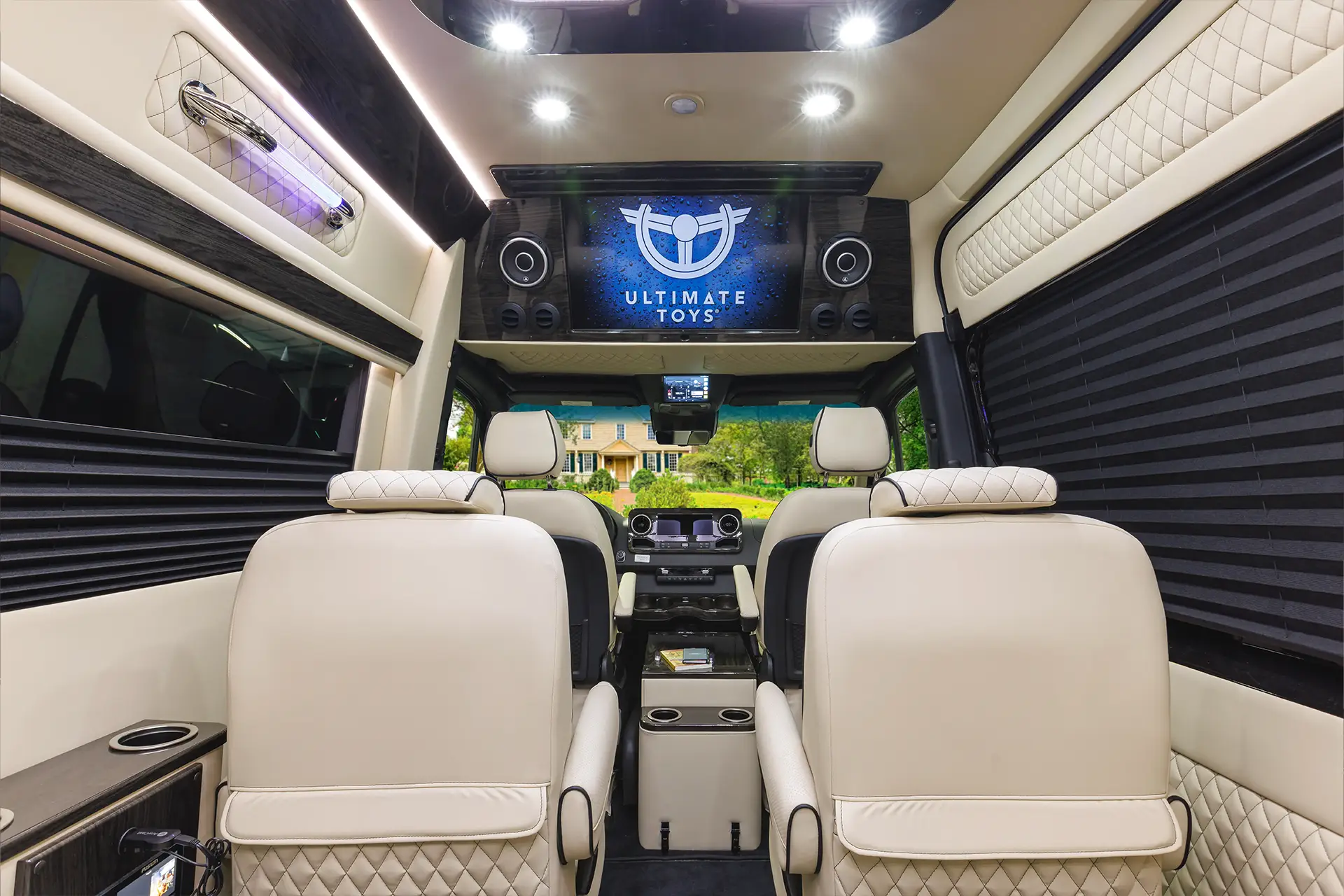
You will not see the system. There are no visible monitors, no blinking lights, no indication that anything unusual is operating. The cameras are integrated into the vehicle’s architecture. The AI runs silently. The cloud connectivity is invisible.
What you have, from the moment the journey begins to the moment you step out, is continuous oversight by a system that was built to prevent the worst outcomes in the most demanding operating environment in ground transportation — and that now applies that same vigilance to every mile you travel with us.
The AI does not take breaks. It does not get distracted. It does not look at its phone. It watches everything, all the time. And if anything is off — speed, attention, lane position, following distance — it acts before the situation becomes an incident.
That is the standard. Not because the industry requires it. Because we do.
Review our full safety credentials, or reserve your Sprinter.